
It would be an opportunity for the business leaders to establish trilateral companies, especially in areas such as transport, maritime and aviation sector.
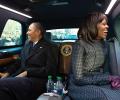
US President Barack Obama told Prime Minister Narendra Modi, when the two met on the sidelines of the East Asia Summit in Myanmar in November 2014, how he barely had two years left to his presidential term and so much to do. The wish list included getting his daughters to see a tiger in the wild and the Taj Mahal.

British Prime Minister Boris Johnson, who landed in Ahmedabad on Thursday morning on a two-day India visit, was accorded a grand welcome at the airport in Ahmedabad. Soon after, he visited Sabarmati Ashram in the company of Gujarat Chief Minister Bhupesh Patel.

Prime Minister Narendra Modi arrived in Suva in Fiji in Fiji on Tuesday night for a day-long visit, the first by an Indian premier to the country in 33 years, during which he will hold bilateral talks with his counterpart Frank Bainimarama.
'Does the country risk being enclosed in a geographical cocoon if it spurns a multi-continent project for which everyone else has signed up,' asks T N Ninan.

Trade between India and Indonesia stands at $20 billion.

The strategic pacts were inked after the summit between Prime Minister Narendra Modi and his Japanese counterpart Shinzo Abe during which they also discussed international and regional issues of mutual importance including UN security reforms.

India's full membership of the grouping would extend its reach to the Central Asian region in whose peace and stability it is a major stakeholder, says Sana Hashmi.

The visit of Park Geun-Hye to India, though a symbolic one, will certainly give a further impetus to the strategic partnership between the two countries says Rup Narayan Das.

Moon Jae-in's visit will play a crucial role in exploring complementarities between India's Act East policy and South Korea's New Southern policy, says Dr Rahul Mishra.
Japanese auto giant Suzuki Motor Corporation on Tuesday said it plans to make India an export hub for its small cars, mainly for European and African markets.

Joe Biden's B3W proposal aims to bring democracies together. India should come up with its own plans to contribute to the initiative, states Rahul Mishra.

How much are others responsible for the Trump presidency moving in the directions it has, asks T N Ninan.

'Both have a very nationalistic view of foreign policy.' 'They think they are shrewd and clever diplomats.'

'During his visit to Vietnam on September 3 -- the first visit by an Indian prime minister in 15 years -- Modi will notice the widespread anti-China sentiment in that country.'
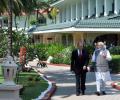
Big ticket defence deals including purchase of missile systems, frigates and joint production of helicopters were sealed on Saturday.

With its political colour dominated by less than democratic trends, BRICS currently leaves some of us wondering -- where in this grouping is there an assurance that human freedom will be respected unconditionally? It would be nice to see the new members of BRICS drawn from the ranks of countries wedded to preserving and guarding human freedom, observes Shyam G Menon.

Modi assured Trump that India will try to 'live up to the expectations' of the US and the world and also thanked the US President for speaking 'highly' about India during his trips.
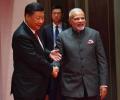
'We must compartmentalise issues, ensuring that one disagreement does not sour everything,' advises Ambassador Kishan S Rana.
Wipro is planning to expand into Sri Lanka and Bangladesh to tap the telecom and banking space, by leveraging on its expertise and strengths in areas such as system integration and IT managed services.

'The big power struggle in faraway Europe erupted at a most critical juncture when India has been increasingly sceptical about American policies and statesmanship,' argues Ambassador M K Bhadrakumar.

'For all of us at Amazon, it is 'Bharat first'.' 'We are keeping the Indian customer at the centre of what we are doing.'

The Korean summit, laden with symbolism in everything from the choice of location to the mango mousse for dessert, could just be the first round in a continuing dialogue, says Dr Rajaram Panda.
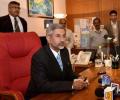
He said that if there are issues that need to be talked about, it is between India and Pakistan.

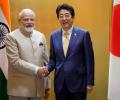
With the signing of the pact, the Quad grouping of India, Japan, Australia and the US is set to gain more heft now, notes Dr Rajaram Panda.

India hopes to bridge gap with US to buffer against a Paris agreement that restricts country's developmental space.

'India alone cannot walk the path of peace. It also has to be Pakistan's journey to make,' says Prime Minister Narendra Modi at the government's geo-political flagship initiative "Raisina Dialogue-II".
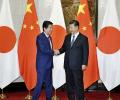
'Both Japan and China face a common challenge: How to deal with Trump.' 'The trade war with the US seems to have facilitated/hastened Abe's China visit, the first by a Japanese prime minister since 2011,' points out Dr Rajaram Panda.
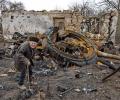
Any Indian government at this juncture would have voted and spoken exactly this way. It isn't just about the vast Indian dependence on Russian-origin military equipment. It is also about trust, asserts Shekhar Gupta.

'Pakistan persists in the belief that such attacks will enable it to obtain the territory it covets. Their plans will not succeed.'

It is important the SCO focus strongly on economic development and regional integration that leads to greater benefits for the least developed regions of member-countries, writes Sana Hashmi.
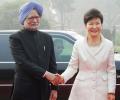
South Korean President Park Geun-hye's visit to India will enhance economic and military ties between the two countries and give the relationship a strategic dimension, says Jiye Kim.

Imran Khan knows Pakistan is holding a strong hand and doesn't have to flaunt it while claiming victory. But Pakistan has learned from the experience of the 1990s -- high risk of going out on a limb, asserts Ambassador M K Bhadrakumar.

Modi regretted that the international response to terrorism was weak and said more cooperation was needed to fight the menace.

China sees India and Japan's 'North East Road Network Connectivity Improvement Project' as a challenge to its OBOR, says Rajaram Panda.

India and Japan are set to intensify defence cooperation with the two sides likely to launch a security consultative framework involving their foreign and defence ministers.

The two sides signed three agreements to boost cooperation in power, banking and insurance sectors besides deciding to step up ties in areas of oil and gas, agriculture, renewable energy and health care.

'This novel format of diplomacy -- the informal summit -- will not only facilitate bilateral communication and reduce miscalculations at the very top level of the two governments, but possibly open the space for China and India to speak in one voice on various issues of mutual concern,' note Feng Renjie and Ding Kun Lei

The two countries also asked all nations to stop cross-border movement of terrorists and asserted that a decisive collective response from the international community without 'double standards and selectivity' was required to combat the threat of terrorism.
